
Blog
How to Choose an Interior Designer in 2026: A Buyer’s Checklist and FAQ

Choosing an interior designer is one of the biggest discretionary decisions a homeowner makes — and one of the least standardised. Fees, scope and deliverables vary enormously, and the glossiest portfolio isn’t always the safest choice. This guide gives you a practical, vendor-neutral framework for choosing well in 2026, wherever you are and whatever your budget.
Step 1: Define your scope before you talk to anyone
Be honest about which of these you actually need:
- Design only (drawings and specifications you build from).
- Full turnkey (design plus the build plus furniture).
- Furniture/FF&E only (you already have a good base).
- Single room (focused, faster).
Getting this right first prevents you from over-buying. A new-build owner rarely needs full turnkey; a bare-shell renovation usually does.
Step 2: Understand the pricing model you’re being offered
There are four common models, each with a different risk profile:
- Per square foot / per square metre — predictable, easy to compare. (Design-only per-square-foot rates range widely by market: roughly £50/m² for basic UK space planning up to £300–350/m² for full London service; AED 175–550/sq ft for design-only in Dubai.)
- Flat/fixed project fee — good cost certainty if scope is well defined.
- Hourly — flexible but uncertain; cap the hours.
- Percentage of project cost — common for full-service (Ireland 8–20%, UK 10–25%, Dubai 10–20%), but the final number is unknown until the end.
A fixed, published per-square-foot or per-project price (as Crosby Project uses — from ₹100/sq ft for design, from ₹3,500/sq ft turnkey) gives you the most upfront certainty; a percentage or hourly model gives the least. Neither is “wrong,” but know which you’re signing.
Step 3: Judge the deliverables, not the renders
Renders sell; drawings build. Ask every candidate for a sample working drawing and a sample BOQ, not just pretty visuals. The best documentation includes a BIM model (ideally LOD 300/350), full working drawings (floor plans, reflected ceiling plan, electrical single-line diagram, plumbing isometrics, joinery shop drawings), a BOQ, a Material & Finish Schedule and — importantly — editable source files (RVT/DWG/IFC) so you’re never locked to one firm. A designer who delivers only mood boards and 3D views is selling you a smaller, riskier product.
Step 4: Scrutinise the payment terms
This is where you protect your money. Prefer milestone billing where each payment unlocks a named deliverable, and be wary of front-loaded lump sums. For build contracts, look for a defect-liability retention — a slice (commonly around 10%) held for months after completion and released only when defects are fixed. Crosby’s schedules illustrate the pattern: 30/20/30/20 across four stages for design, and 30/20/20/20/10 for turnkey with a 6-month retention released on a Certificate of Making Good Defects. Whatever firm you choose, insist the schedule names deliverables and includes a change-order (Variation Order) process.
Step 5: Check warranties and after-sales
Understand exactly what is warranted and for how long. Indian branded platforms are known for long modular product warranties — for example, Livspace publishes cover of up to 30 years on cabinets, shutters, drawers and panels and 10 years on hardware and accessories, HomeLane a 10-year warranty, and Bonito Designs a 10-year product / 1-year service warranty. A construction defect-liability retention and a product warranty are different protections — ideally you want both spelled out in writing.
Step 6: Confirm they can actually serve you
- Location and logistics: can they work remotely if you’re abroad? Do they offer VR walkthroughs and digital reviews?
- Currency and tax: for cross-border work, can they bill in your currency and handle the correct tax treatment (for overseas clients, an Indian firm’s design service is typically a zero-rated export)?
- Track record and capacity: how long established, and do they manufacture in-house or subcontract? (Crosby, for instance, cites a 5-year studio track record, 100% in-house manufacturing and a 50+ artisan workshop.)
Step 7: Compare fairly and get everything in writing
Put two or three proposals side by side on a single sheet: scope, deliverables (with file formats), price and pricing model, payment schedule, warranty/retention, timeline and change-order terms. The best choice is usually the one that is clearest and most complete — not merely the cheapest or the prettiest.
FAQ
How much does an interior designer cost in 2026? It depends on market and scope. Design-only fees range from roughly £50/m² (UK basic) to AED 175–550/sq ft (Dubai); single-room design starts around €500 in Ireland and £1,500 in the UK; full-home design schemes typically begin around €15,000 (Ireland) or £15,000+ (UK). India-based studios can be dramatically lower for design-only — Crosby publishes from ₹100/sq ft (≈ €0.91 / AED 3.9 at September 2026 rates).
What’s the difference between design-only and turnkey? Design-only delivers the drawings and specifications; you (or a local contractor) build. Turnkey delivers design plus the entire build plus furniture under one contract, ending with a handover.
Should I pay a deposit up front? A retainer to start is normal (commonly ~30%), but avoid paying most or all of the fee before you receive deliverables. Prefer a milestone schedule where each payment buys a defined output.
Can I hire an Indian designer for a home in Ireland or the UAE? Yes. With BIM documentation, VR walkthroughs and staged pay-on-delivery billing, remote design is now practical. You’ll still need a local contractor to build, and the design service is typically billed as a zero-rated export.
What documents should I receive at the end? At minimum: working drawings, a BOQ, a Material & Finish Schedule, renders, and editable source files (RVT/DWG/IFC). For a build, also a snag-list resolution and any warranty/retention certificate (e.g., a CMGD).
How do I avoid budget overruns? Insist on a defined BOQ, a milestone payment schedule and a written change-order process. Published cost data repeatedly shows large gaps between first quote and final cost when scope is loose — complete documentation is the fix.
The bottom line
Choose on clarity and completeness: a defined scope, deliverables you can build from and keep, a milestone payment schedule with a defect retention, and a firm that can genuinely serve your location and budget. A fixed-price, documentation-led studio such as Crosby Project scores well against this checklist — but the checklist itself is the tool that will protect you whoever you hire. You can benchmark scope, price and staged payments instantly on Crosby’s design-services page.
Internal/anchor links:
- “Crosby’s transparent fixed pricing” → https://thecrosbystore.com/design-services/
- “see the full deliverables and payment stages” → https://thecrosbystore.com/design-services/
- “about the studio” → https://thecrosbystore.com/company/
- “book a free consultation” → https://thecrosbystore.com/contact/
keywords: how to choose an interior designer, interior designer checklist, interior design pricing models, questions to ask interior designer, interior design warranty, design only vs turnkey, interior designer fees 2026, best interior design service
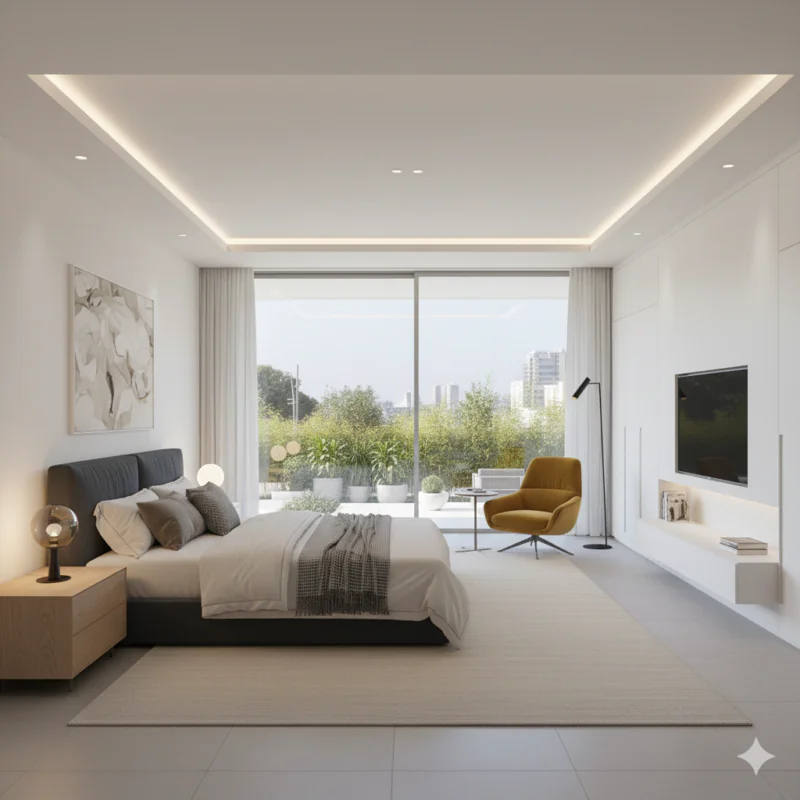








 Bedroom


